
"Wars are not won by evacuations."

There are no German soldiers in Dunkirk. Celebrated auteur Christopher Nolan has twisted his trademark filmmaking style to meticulously craft a self-contained war drama about the titular 1940 World War II evacuation (code-named Operation Dynamo). Dunkirk is a sweeping, ambitiously told thriller and time-fractured triptych, told through soldiers at ground level (one week), by sea (one day), and by air (one hour).
Full of welcome contradictions, the minimalist yet ready-made story is seen only from the point of view of stranded French, Belgian, and British soldiers at the onset of WWII, and is told through the largest canvases ever filmed (and screened where available) on 70mm film. The fictionalized dramatization features almost no dialogue and little exposition as we follow soldiers desperate to escape their perilous position, attacked on all sides.
Some 400,000 mostly English soldiers, three of whom we follow played by Fionn Whitehead, Harry Styles, and Aneurin Barnard, wait to be rescued off the trapped French beach. Nolan inverts the expectations and tension of war by focusing on the stranded, trapped, and waiting, where the more conventional action occurs elsewhere.
Even the veteran performances from the likes of acting heavyweights Kenneth Branagh, Mark Rylance, Cillian Murphy, and Tom Hardy as a colonel, fighter pilot, shell-shocked seaman, and civilian volunteer are minimalist yet wholly effective in their understated execution. The sprawling yet scant ensemble of entirely English actors makes the insular setting of war particularly vivid.
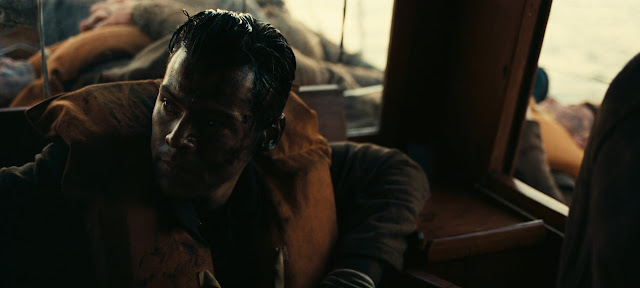
Enough cannot be said about cinematographer Hoyte Van Hoytema's stunning visuals flawlessly edited together through time and place. It builds the minimalist performances and scope of mostly aimless young British soldiers waiting for rescue or death.
We cut back and forth through the three separate compressed time periods, crisscrossing across the sea and beach, before the miraculous rescue comes together. Set to Hans Zimmer's propulsive musical score, Dunkirk is truly an exceptional work of blending all the different elements of film together fluidly for a completely defined story told rather inventively, as long as Nolan could.
Dunkirk is an exercise in indulging Nolan's best and worst tendencies, from fractured storytelling and messily convoluted narratives to masculine duty. His brand of propulsive yet coldly complex expression fits splendidly into this version of historical filmmaking. Even the bloodlessness adds to the unnerving yet intimate landscape. The violence is very real, but removed as the infinite landscape dictates their distance from the situation, despite being so close to home.
At a tight 106 minutes, Dunkirk wastes very little, and every detail moves the arthouse-meets-prestige-style war drama forward. It's a masterfully made picture, told with a clear purpose and using historical context to frame its unconventional storytelling. Nolan's use of time and location precisely executes his clear cinematic vision. It's a fine entry in his sprawling filmography, playing as another narrative puzzle and cinematic trick that works impeccably.
Dunkirk screens in 70mm exclusively at The Park Theatre and in IMAX 70mm at Cineplex Cinemas Langley.
More | YVArcade / Indiewire / ScreenCrush / Vox


0 reactions:
Post a Comment